eGraphene for Cathodes: More Active Material, More Energy Density
In established Li-ion chemistries, energy density is increasingly limited by inactive material. Learn how conductive additives influence active material share, electrode compression, and ultimately cell performance.
For established lithium-ion battery chemistries such as LFP and NMC, improving energy density has become increasingly difficult. The industry has already optimized active materials, cell designs, and manufacturing processes over decades. As a result, many future gains will no longer come from entirely new chemistries, but from improving how efficiently existing electrode architectures utilize the available volume.
One of the most important levers is often overlooked: Reducing the amount of inactive material inside the electrode.
## The Active Material Challenge
A battery electrode is not made from active material alone. In addition to the cathode active material, every electrode contains:
conductive additives
binders
pores and electrolyte
current collectors
None of these components directly store energy. Their purpose is to enable electron transport, mechanical stability, ion transport, and manufacturability.
The challenge is obvious: Every percentage point occupied by inactive material is unavailable for active material. Increasing the share of active material therefore remains one of the most effective ways to improve energy density without fundamentally changing cell chemistry.
## Why Conductive Additives Matter
Cathode active materials' electronic conductivity is a power limiting factor, especially LFP is almost an isolator. Without conductive additives, electrons cannot move efficiently through the electrode, resulting in higher resistance, reduced power capability, and reduced utilization of the active material.
Carbon black has therefore become the standard conductive additive across many lithium-ion battery chemistries. Its spherical particle geometry allows it to form conductive pathways throughout the electrode. However, establishing a continuous conductive network often requires relatively high loading levels. These conductive additives contribute little to energy storage while occupying valuable electrode volume and mass.
## Building Conductive Networks More Efficiently
The effectiveness of a conductive additive is strongly influenced by its geometry. Carbon black consists of approximately spherical particles. Graphene, by contrast, consists of thin two-dimensional flakes with a significantly larger contact area.
As a result, individual graphene flakes can connect multiple active material particles simultaneously, increasing the efficiency of the conductive network. This means that similar conductivity can potentially be achieved with substantially lower conductive additive loading.
In validated LFP formulations, conductivity comparable to conventional systems has been achieved by replacing approximately 2 wt% carbon black with a combination of approximately 0.2 wt% eGraphene and 0.2 wt% carbon black. This corresponds to an approximately 80% reduction in total conductive additive content.
The immediate consequence is straightforward: More space becomes available for active material.
## Conductivity Is Only Part of the Story
The impact of conductive additives extends beyond conductivity alone. The physical structure of the additive also influences how particles behave during electrode processing.
One particularly important manufacturing step is calendering. During calendering, electrodes are compressed to increase density, improve particle contact, and optimize electrochemical performance. Recent tests indicate that eGraphene can influence electrode compression behavior during calendering. The large, flexible 2D flakes appear to modify particle packing and flow characteristics, enabling higher electrode compression under comparable processing conditions.
Depending on formulation and electrode system, this translated into electrodes that were up to approximately 3% thinner. For a battery manufacturer, thinner electrodes at identical active material loading directly translate into higher volumetric energy density.
## The Binder Effect
A third lever emerges from the interaction between conductive additives, binder systems, and current collectors. Because graphene provides a large surface area and extended contact zones within the electrode, it can contribute to improved adhesion between electrode components. This can create opportunities to reduce binder content while maintaining mechanical integrity.
Since binders are another inactive component, reducing their share further increases the proportion of active material within the electrode. In some systems, reductions of up to approximately 30% in binder demand have been observed.
## Small Improvements Become Large Effects
Individually, each of these mechanisms appears relatively modest.
lower conductive additive loading
improved electrode compression
reduced binder demand
However, all three effects point in the same direction: Reducing inactive material.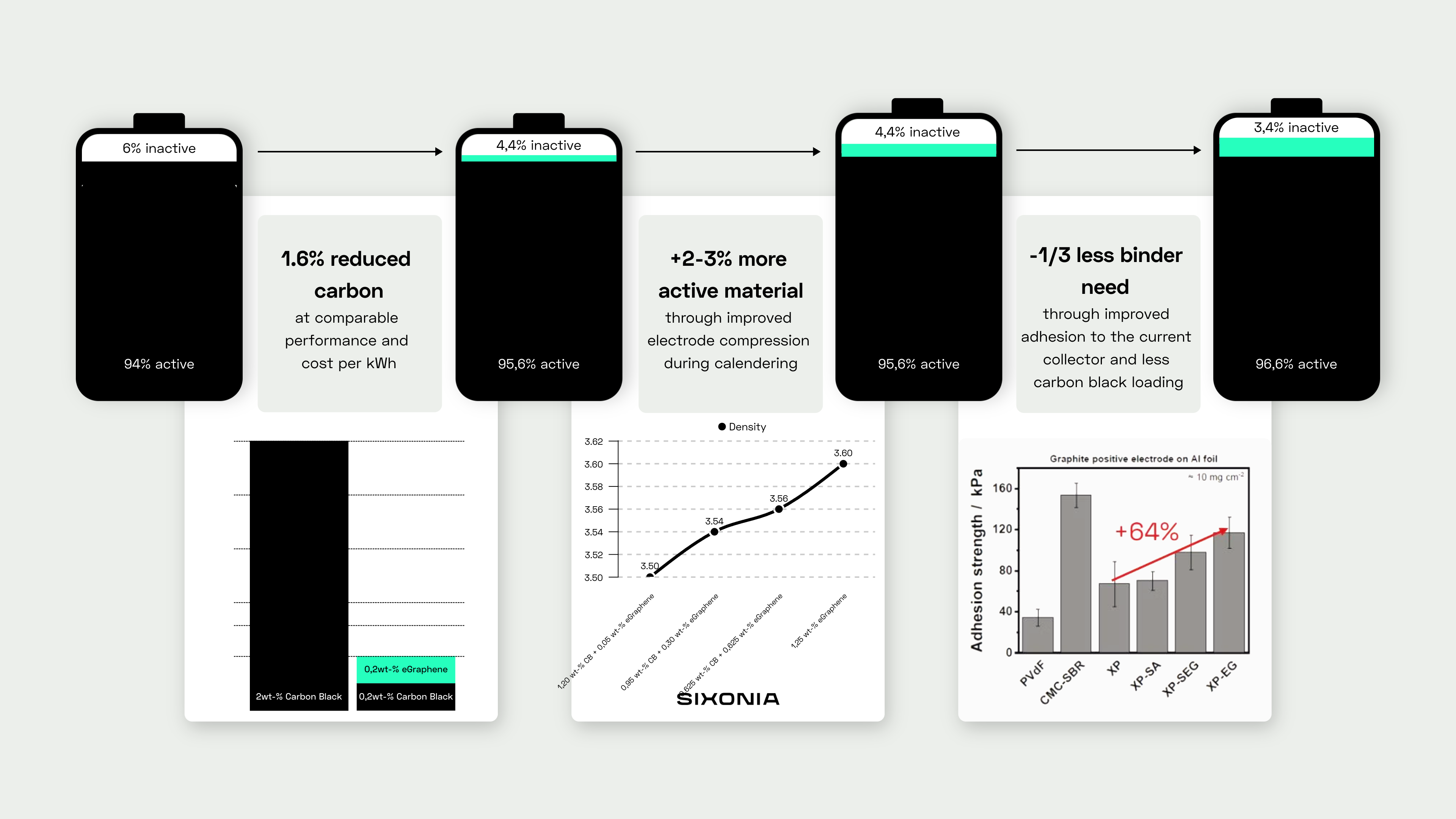
When combined, they can free up to approximately 5% additional space for active material at the electrode level while maintaining comparable cost structures to conventional conductive additive systems. For battery developers, this is important because increasing active material share is one of the few remaining levers that can improve energy density without requiring entirely new cell chemistries.
## More Energy from Existing Chemistries
The next generation of lithium-ion batteries will certainly include new materials and new cell concepts. At the same time, existing chemistries such as LFP and NMC still offer significant optimization potential. Much of that potential lies not in changing the active material itself, but in reducing the amount of material surrounding it.
Conductive additives have traditionally been viewed as necessary inactive components. As conductive network design becomes more sophisticated, they increasingly become a tool for maximizing active material utilization. In that context, improving conductivity is only part of the objective.
The larger goal is creating more space for the material that actually stores energy.