The Graphene Dilemma: Why Graphene Has Not Become a Standard Battery Material
Graphene has long promised to transform battery performance, yet it has not become a standard battery material. The reason is not conductivity—it is the challenge of combining performance, processability, and scalability.
Graphene has been called a wonder material for more than a decade. Its combination of high electrical conductivity, mechanical strength, flexibility, and chemical stability has inspired countless applications across energy storage, electronics, coatings, composites, and many other industries. In batteries, graphene appeared particularly attractive.
As a highly conductive carbon material with a large specific surface area, it promised to improve electron transport while reducing the amount of inactive material required inside an electrode. Yet despite thousands of scientific publications and hundreds of companies attempting commercialization, graphene has not become a standard battery material.
Why? The answer is not performance. The answer is processability.
## The Graphene Dilemma
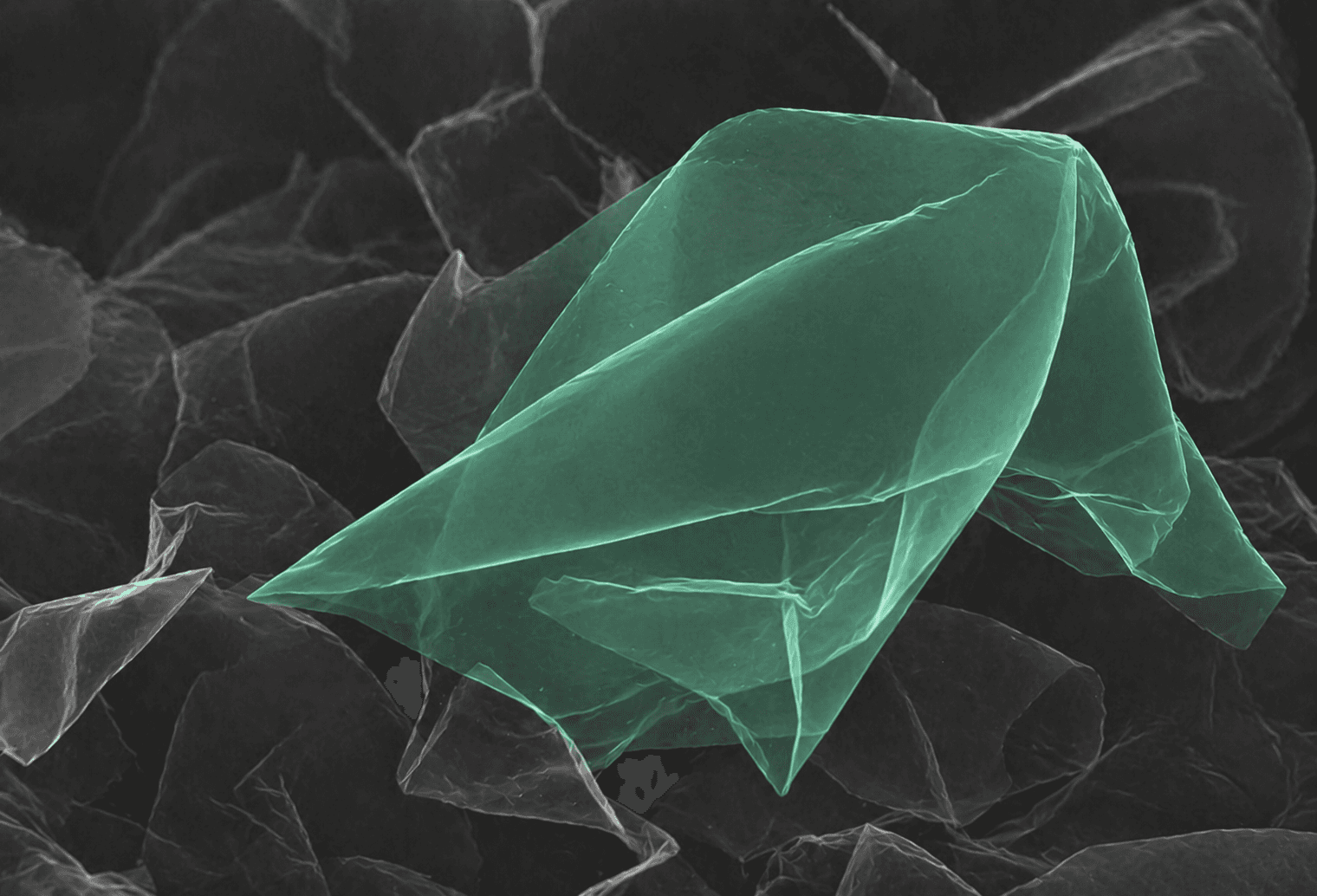
At first glance, graphene appears to be an ideal conductive additive. A graphene flake consists of a two-dimensional network of carbon atoms arranged in a hexagonal lattice. Electrons can move efficiently through this structure, giving graphene exceptional electrical conductivity.
However, the same properties that make graphene attractive also create a fundamental challenge: Graphene sheets have a strong tendency to restack.
Individual flakes are held together by van der Waals forces. Once dispersed in a liquid or dried into a powder, they naturally tend to collapse back onto one another, forming graphite-like structures again. As this happens, much of the accessible surface area and many of the advantages of graphene are lost. As a result, highly conductive graphene materials are often difficult to process.
## Traditional Solutions to the Problem
Over the years, two main approaches have emerged to make graphene processable.
### Oxidation-Based Graphene
One approach is to introduce oxygen-containing functional groups onto the graphene surface.
The resulting graphene oxide (GO) disperses well in liquids and is less prone to restacking. However, the oxidation process disrupts the conductive carbon lattice, significantly reducing electrical conductivity. Additional reduction steps can partially restore conductivity, but often not to the level of pristine graphene.
### Mechanical Exfoliation
Another common approach is mechanical or liquid-phase exfoliation. Here, graphite is separated into graphene flakes using shear forces, milling, or ultrasonic energy.
This route can produce stable dispersions, but it introduces a different compromise. The graphene flakes tend to become relatively small, reducing their aspect ratio and limiting their ability to form efficient conductive networks. In addition, surfactants are often required to stabilize the material and prevent re-agglomeration.
For battery manufacturers, these surfactants become additional components within an already highly optimized electrode formulation. Both approaches solve part of the graphene challenge, but neither fully resolves the trade-off between conductivity, processability, and industrial compatibility.
## Why Processability Matters More Than Performance
For battery manufacturers, performance alone is rarely enough. A new material must also integrate into existing manufacturing processes.
If a conductive additive requires special solvents, additional surfactants, new mixing procedures, or significant process modifications, qualification becomes more difficult and adoption becomes less likely. This is particularly true in battery manufacturing, where production lines represent investments of hundreds of millions of euros and process stability is critical. A material that performs well in a laboratory but cannot be processed reliably at industrial scale will struggle to achieve adoption.
## A Different Approach: Functionalization During Exfoliation
One way to overcome the conductivity-processability trade-off is to address the problem at the moment graphene is formed. Instead of producing graphene first and modifying it afterwards, functional groups can be introduced during the exfoliation process itself. This approach is known as in-situ functionalization.
During electrochemical exfoliation, graphite layers are separated into few-layer graphene flakes. At the same time, functional groups are attached directly to newly exposed graphene surfaces. The objective is not to oxidize the material heavily. Rather, the goal is to introduce surface charges through functionalization, whose repulsive forces prevent restacking, thereby creating stable dispersions while preserving the conductive graphene structure.
The resulting material combines two characteristics that are traditionally difficult to achieve simultaneously, high electrical conductivity and stable, surfactant-free processability.
## Why Surfactant-Free Processing Matters
Many nanomaterials rely on surfactants to remain dispersed. While effective for stabilization, surfactants often become unwanted components in battery electrodes. They can influence electrochemical behavior, complicate formulation development, and require additional process optimization.
A material that remains stable without surfactants offers a significant advantage. It simplifies integration into existing formulations and reduces the number of variables manufacturers must control. This becomes particularly important in battery production, where formulations are already highly optimized and qualification cycles are long.
## From Laboratory Material to Industrial Material
The history of graphene commercialization shows that performance alone is insufficient. Industrial adoption requires a balance between conductivity, processability, scalability, and cost. This is why the graphene discussion is gradually shifting away from record-breaking material properties and toward practical manufacturing considerations.
The question is no longer: "How conductive can graphene become?"
Instead, it is: "Can graphene be integrated into industrial processes without creating new problems?"
Solving this challenge is ultimately what determines whether graphene remains a promising laboratory material or becomes a widely adopted battery material. And that is where processability becomes just as important as conductivity.