Improving Dry Electrode Manufacturing with eGraphene
Dry electrode manufacturing changes the requirements for conductive additives. Beyond conductivity, particle flow and calendering behavior can become critical factors for successful electrode production.
Battery manufacturers are increasingly exploring dry electrode production. The motivation is straightforward: Dry coating eliminates the need for large amounts of solvent handling, drying energy, solvent recovery infrastructure, and associated production costs. And it allows the production of thicker electrodes without facing the challenge of binder migration, as it occurs in wet coating processes. It has the potential to simplify battery manufacturing while reducing both capital expenditure and operational energy consumption.
As a result, dry coating has become one of the most closely watched developments in battery manufacturing. However, moving from wet-coated electrodes to dry-coated electrodes changes more than just the production process. It changes the requirements for materials.
## The Difference Between Wet and Dry Electrode Manufacturing
In conventional wet coating, conductive additives are dispersed in a liquid slurry together with active material, binder, and solvent. The solvent acts as a temporary processing medium. It helps distribute particles, influences rheology, and supports coating uniformity. After coating, the solvent is removed.
Dry coating removes this processing medium entirely. Instead, powders and granulates must interact directly during mixing, fibrillation, and calendering. As a result, particle flow, friction, packing behavior, and mechanical interactions become significantly more important. A material that performs well in a slurry is not automatically suitable for dry coating.
## The Role of Conductive Additives in Dry Coating
Conductive additives are traditionally evaluated based on their ability to form electronic networks. For dry coating, this is only part of the challenge. The conductive additive also becomes part of the mechanical system that determines how powders flow and compact during processing.
This introduces additional requirements:
flowability
granulate stability
powder handling
particle packing
calendering behavior
In other words, conductivity alone is no longer sufficient.
## Why Graphene Requires a Different Formulation
eGraphene is typically supplied as a dispersion or paste. This is intentional. The liquid environment helps prevent graphene flakes from restacking and allows them to be integrated into wet electrode manufacturing processes.
For dry coating, however, a liquid formulation is no longer suitable. The challenge, therefore, becomes: How can graphene be delivered in a dry form while preserving its processability? Simply drying eGraphene into a powder leads to unintended restacking to graphitic material that loses the properties of graphene. This requires a different material format.
## From Dispersions to Dry Agglomerates
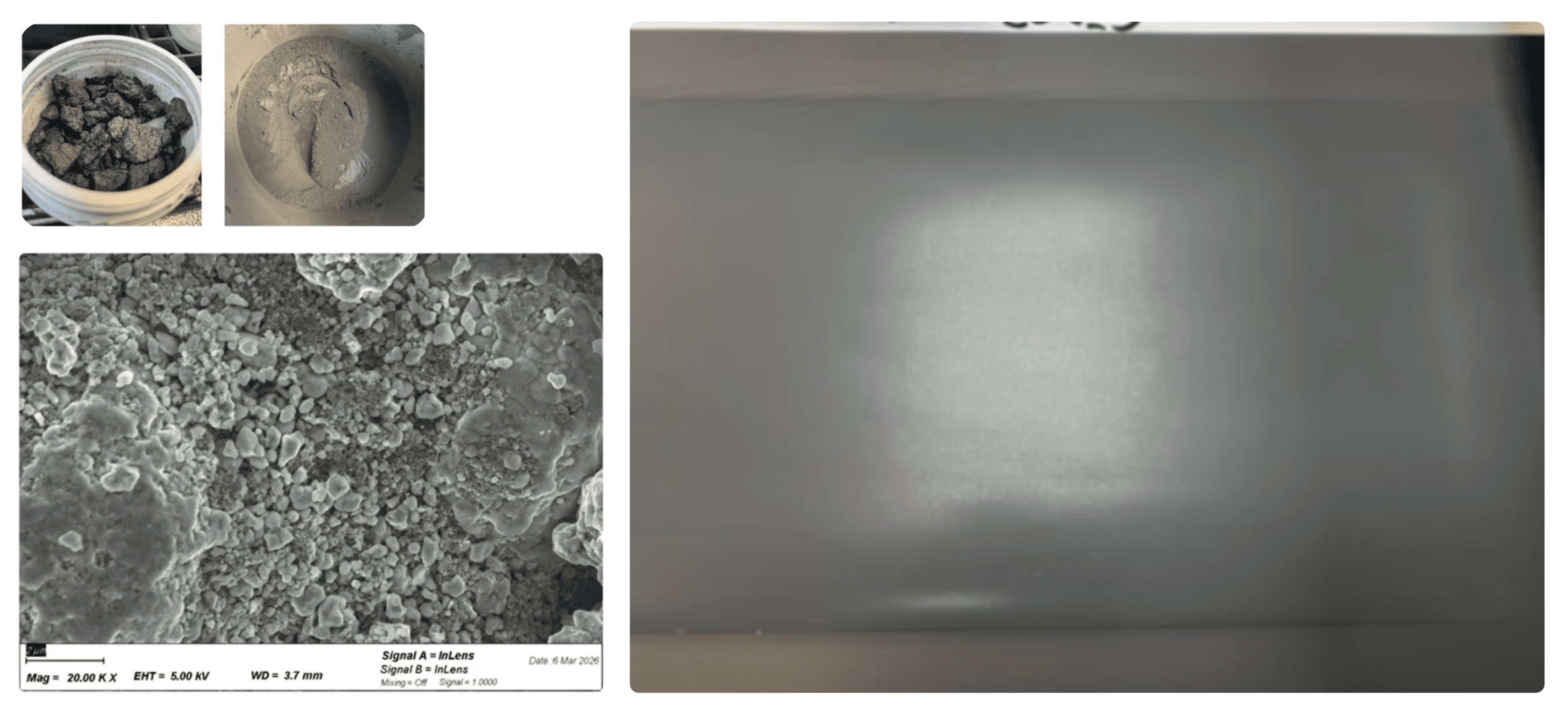
To address dry electrode manufacturing, eGraphene was reformulated into dry agglomerates. These granulates remain easy to handle and transport while de-agglomerating under shear forces during powder mixing and electrode production. The objective is not to preserve large dry particles throughout the process.
Instead, the granulate acts as a carrier format that releases graphene during manufacturing. This enables graphene integration into dry-coated electrodes while maintaining compatibility with industrial powder handling processes.
## Conductive Additives as Rheology Additives
Recent testing at a cell manufacturer revealed an additional effect. Beyond conductivity, eGraphene appeared to influence granulate behavior during calendering. The large, flexible 2D flakes seem to modify how particles move relative to one another during compression.
In practical terms, eGraphene acted similarly to a rheology additive. The material appeared to improve granulate flow and packing behavior during calendering, effectively reducing friction within the powder mixture. While the exact mechanisms continue to be investigated, the observed impact was significant from a manufacturing perspective.
## Opening New Processing Windows
Improved flowability can directly influence the quality of dry-coated electrodes. Observed benefits included:
improved processability during dry coating
wider processing windows
thinner cathodes and anodes
more uniform electrode structures
Particularly noteworthy was the ability to produce electrodes well below 100 µm thickness. For battery manufacturers, thinner electrodes can enable higher energy power density, improved process control, and greater flexibility in cell design.